Harmonic distortion
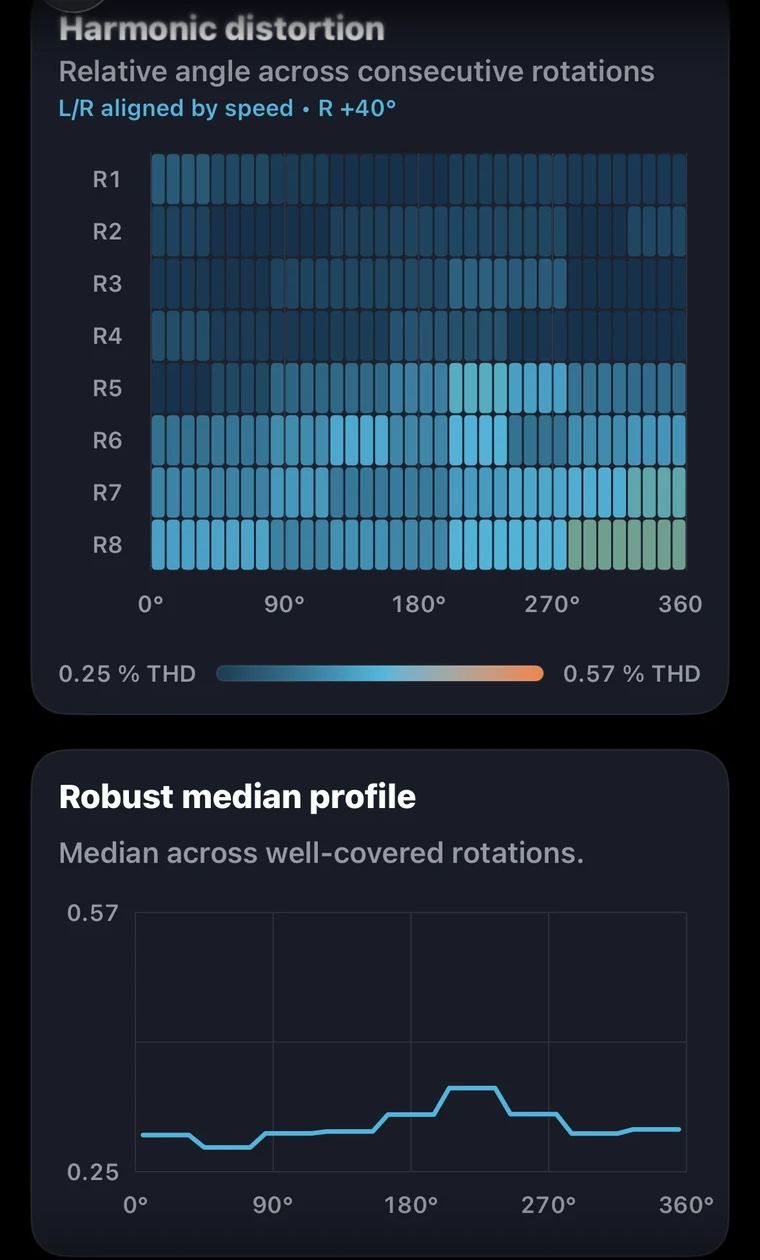
Left channel selected
Groove Scope measurement · GS-2026-0003
A measured view of rotational behaviour, channel performance and harmonic structure in one documented analogue playback chain.
Measurement at a glance
Values are transcribed from the preserved Groove Scope PDF. Together they form a capture-specific view of primary performance and supporting channel behaviour.
Rotation fingerprints
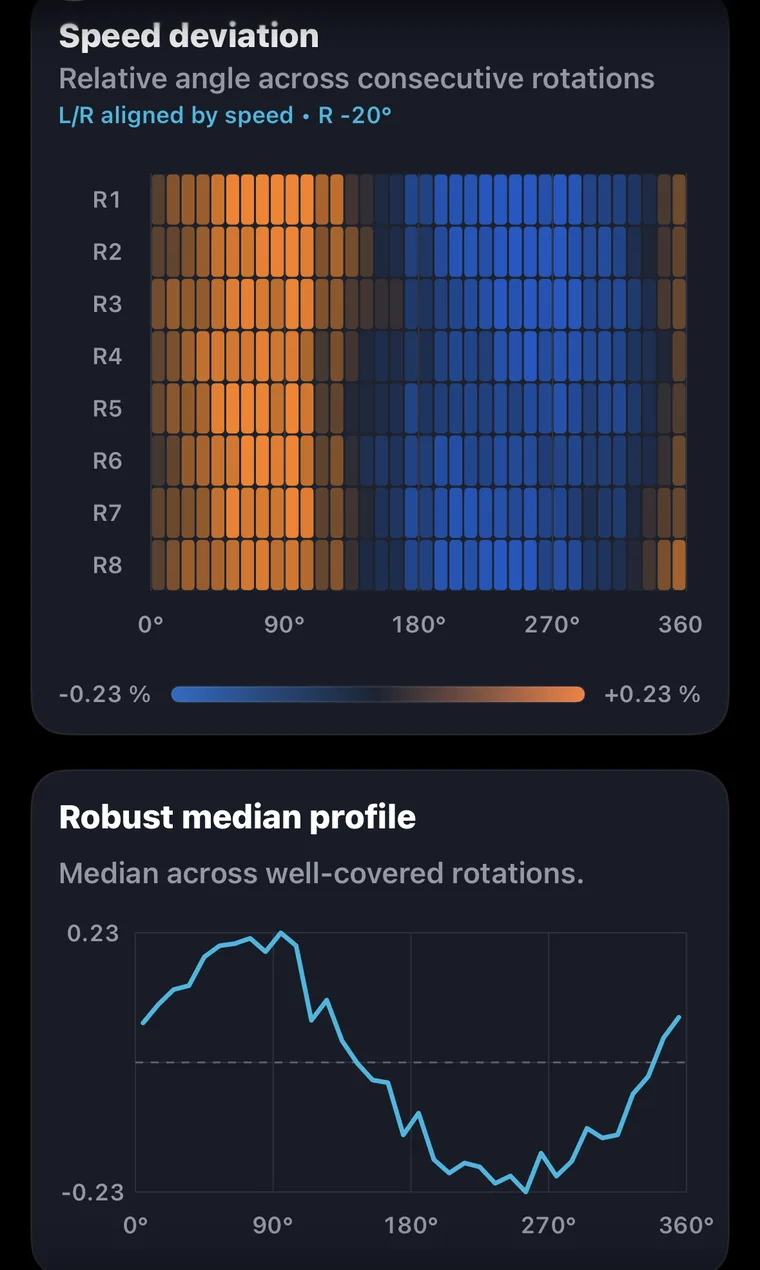
Each view combines the angular heatmap and robust median profile produced by Groove Scope. Choose L or R independently on each card. Display spacing is aligned and the extra left THD resolution label is omitted; plotted data is unchanged.
Left channel selected
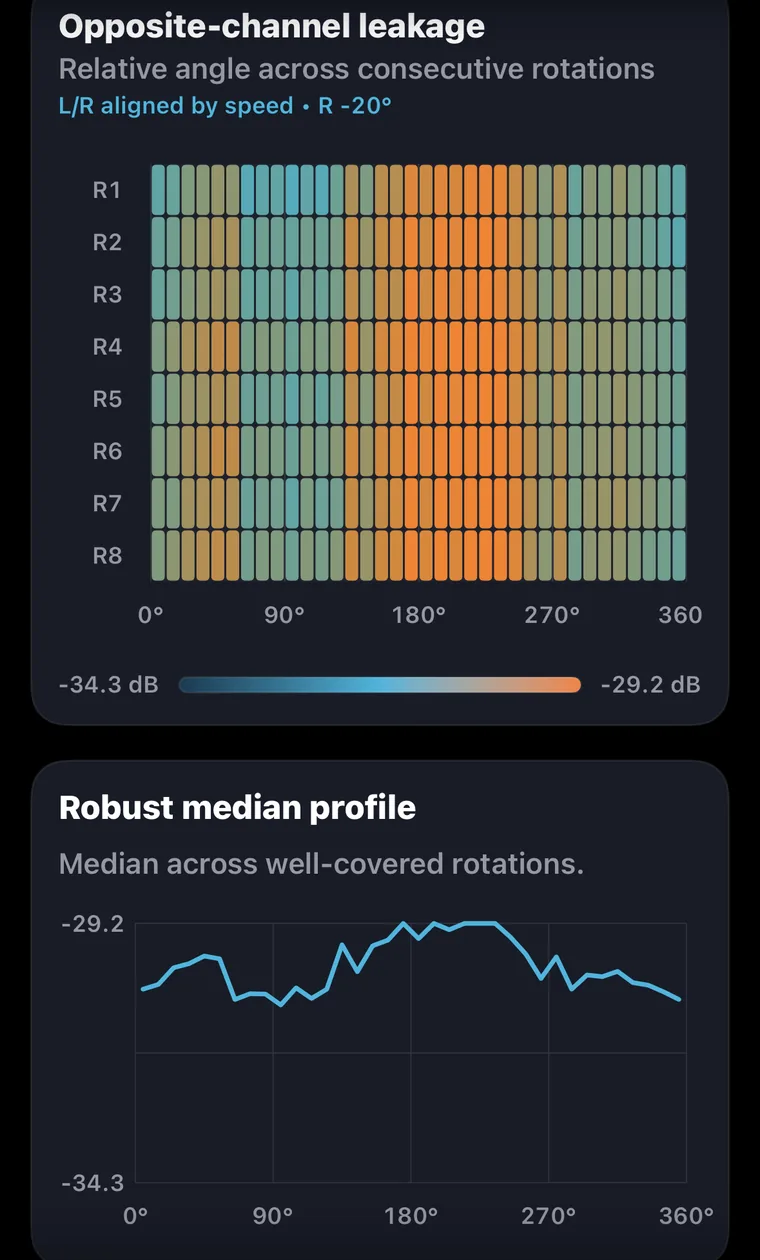
Left channel selected
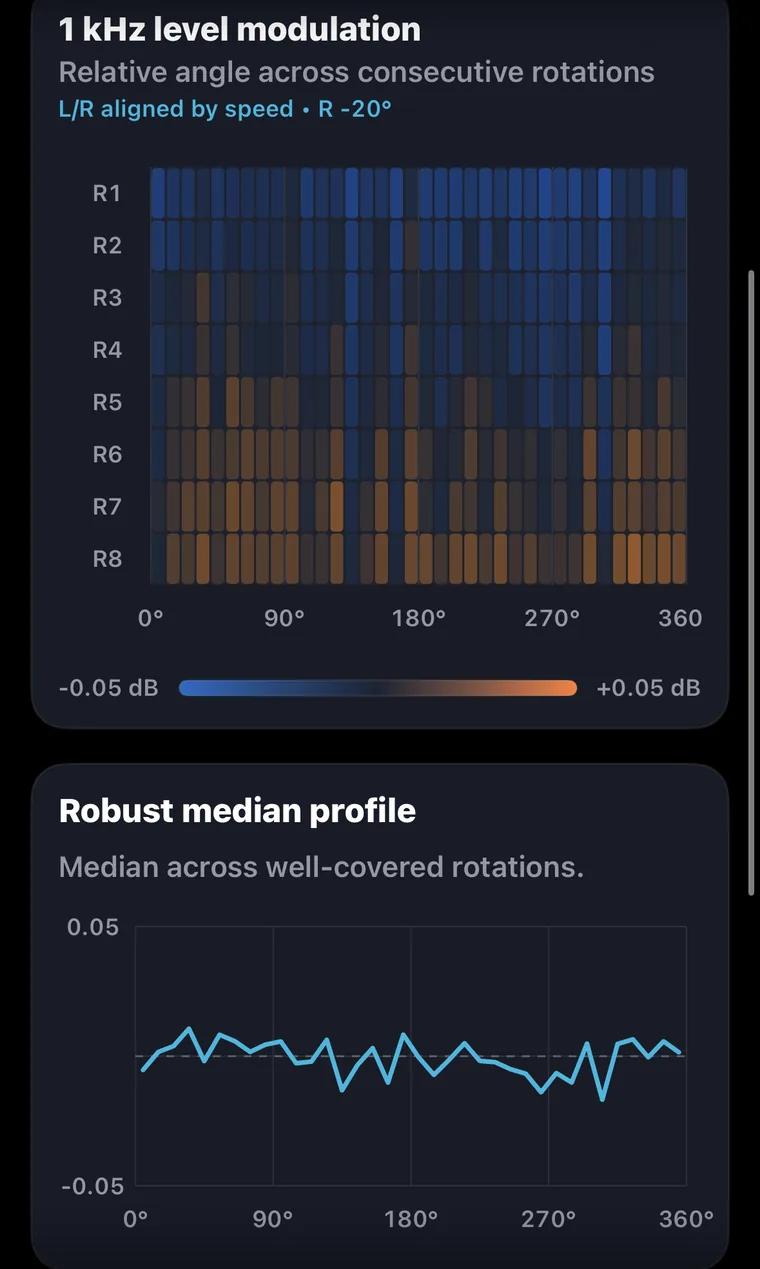
Left channel selected
Left channel selected
On smaller screens, swipe horizontally to compare all four cards. The source views show eight consecutive rotations (R1–R8) where supplied.
Behind the measurement
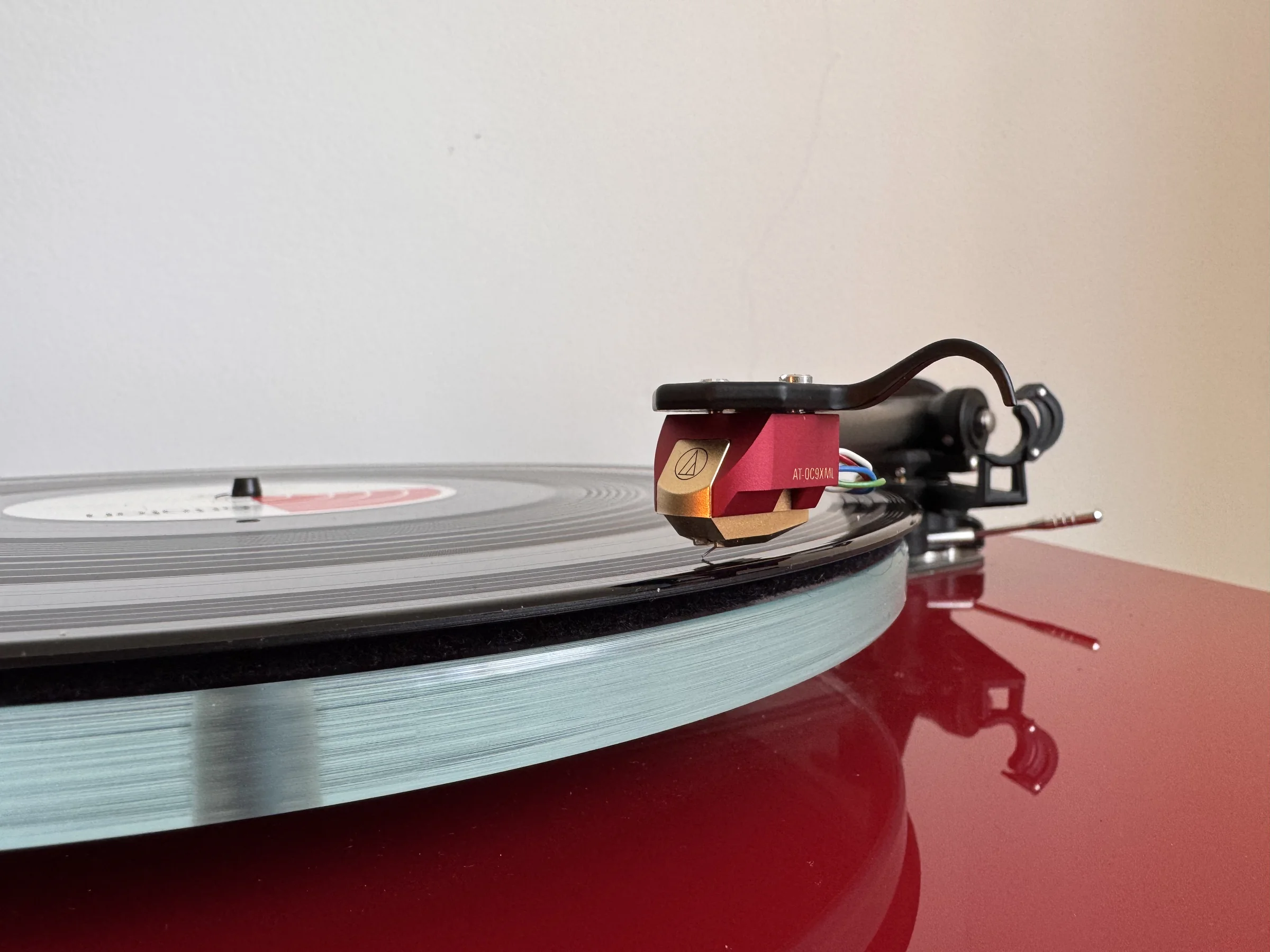
The Rega P3 was positioned on a wall shelf for this session, with the AT-OC9XML’s overhang checked and confirmed correctly aligned on the RB330 arm. Tracking force was measured at 2 g. The signal then passed through the Audio Research SP20 preamplifier—the centrepiece of this playback chain—into the input identified in the report as EVO4.
With those setup details established, the interesting question is what happens as the groove comes around again. Groove Scope follows the 1 kHz tone across eight consecutive revolutions, placing speed, level, leakage and distortion against relative platter angle. A recurring feature invites a different follow-up from one that moves between rotations; the robust median profile helps reveal what persists.
Here, near-nominal speed and strong channel separation sit alongside a changing left-channel third harmonic. Will that pattern return in a second capture with the same alignment and 2 g tracking force? That is the next comparison this carefully documented setup makes possible.
What stands out
This capture measured 31.8 dB average separation at 1 kHz, with directional results of −30.2 dB L→R and −33.5 dB R→L. Channel balance was −0.24 dB. Playback averaged 33.34 RPM (+0.02%) with 0.030% DIN-shaped wow and flutter; THD was 0.29% left and 0.37% right. The left-channel third harmonic changed most during recording, so repeat before using that diagnostic to guide a setup change.
Measurement chain
Verified components are shown in signal order on one continuous line. Components not used or not verified for a particular method remain absent.
Open technical record
The editorial review connects directly to the source report, structured record, checksums, measurement method and original asset archive.
Measurement results
Every reported numeric result in one place: playback speed, weighted and raw stability, channel behaviour, distortion and the second through fifth harmonics.
| Metric | Measured result |
|---|---|
| Playback speed under stylus load | 33.34 RPM |
| Playback speed error | +0.02% vs 33⅓ RPM |
| Settled speed range | 33.26–33.42 RPM |
| Settled speed span | 0.16 RPM |
| DIN-shaped wow & flutter RMS | 0.030% |
| Raw speed variation RMS | ±0.144% |
| Raw speed variation, 2-sigma | ±0.287% |
| Raw wow RMS | 0.140% |
| Raw flutter RMS | 0.033% |
| Channel balance | −0.24 dB |
| Average channel separation at 1 kHz | 31.8 dB |
| Electrical crosstalk, L→R | −30.2 dB |
| Electrical crosstalk, R→L | −33.5 dB |
| Crosstalk directional difference | 3.27 dB |
| Total harmonic distortion | Left 0.29%; right 0.37% |
| THD difference, L−R | −0.07 percentage points (source report) |
| Second harmonic (H2) | Left −50.8 dB; right −49.0 dB; L−R −1.8 dB |
| Third harmonic (H3) | Left −68.1 dB; right −63.3 dB; L−R −4.8 dB |
| Fourth harmonic (H4) | Left −74.5 dB; right −67.8 dB; L−R −6.7 dB |
| Fifth harmonic (H5) | Left −75.2 dB; right −75.5 dB; L−R +0.3 dB |
Unweighted results complement the DIN-shaped measurement. Channel and harmonic values describe this capture; the report recommends repeating it before changing cartridge setup because the left-channel third harmonic varied most. Differences retain the source report’s precision.